
Author: szr
Topic: Intelligence failure, strategy, and Allied coordination in the Battle of France
Opening
Imagine a moment in history when a seemingly powerful alliance collapsed under the weight of miscommunication, poor judgment, and outdated assumptions. The early defeat of France in World War II is such a case. From today’s perspective, some decisions seem almost unbelievable: warning signs were missed, commands were delayed, and military systems could not adapt quickly enough to the speed of modern warfare.
The Battle of France lasted from May 10 to June 25, 1940. In just over six weeks, German forces overran the Low Countries, pushed the British Expeditionary Force off the continent, captured Paris, and forced the French government to surrender [1]. This defeat was not caused by one single mistake. It was the result of three connected failures: weak intelligence, flawed strategy, and poor coordination.
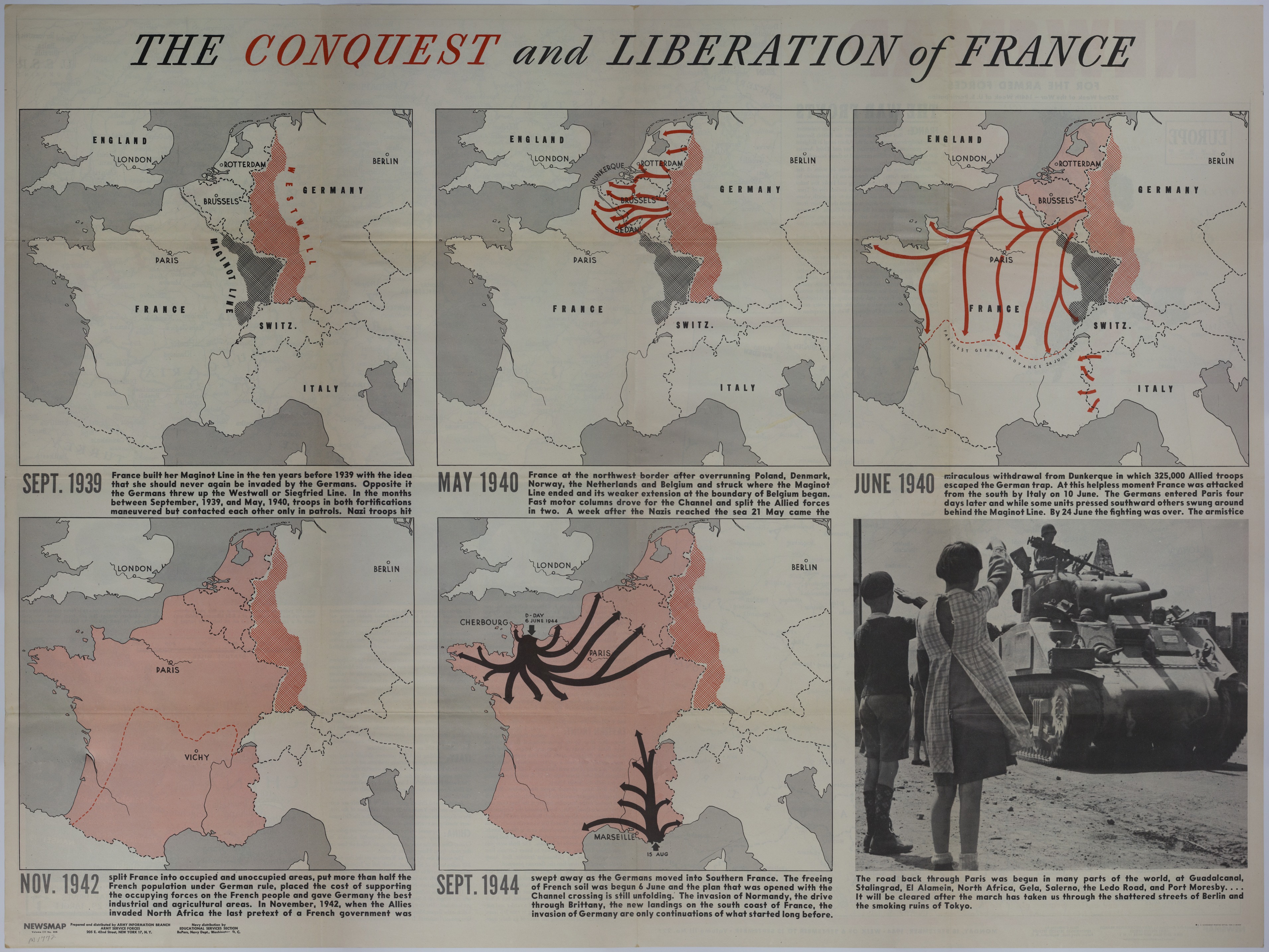
Figure 1. “The Conquest and Liberation of France,” a public-domain map showing the Maginot Line, German advances through the Low Countries and France, and later Allied liberation routes. Source: Harry S. Truman Library & Museum [3].
Intelligence Failure
First, the Allies underestimated German military capability. They misjudged the speed and effectiveness of the German combined-arms offensive, often described as Blitzkrieg. German success depended on fast-moving armor, air support, and concentrated attacks at weak points. Allied planners did not fully anticipate how quickly German forces could break through and exploit confusion.
The most important intelligence failure concerned the Ardennes. Allied commanders treated the forested Ardennes region as difficult terrain for a major armored attack. The German plan exploited exactly that assumption. While Allied forces expected the main pressure to come through Belgium, German Army Group A pushed through the Ardennes and struck near Sedan, hitting the weak hinge of the Allied line [2].
Intelligence problems were not only about collecting information. They were also about interpreting and acting on it. Reports about German troop movements were sometimes conflicting, delayed, or ignored. Early warnings about the German movement through the Ardennes did not produce a fast enough response. As a result, French defenses were exposed at the decisive point.
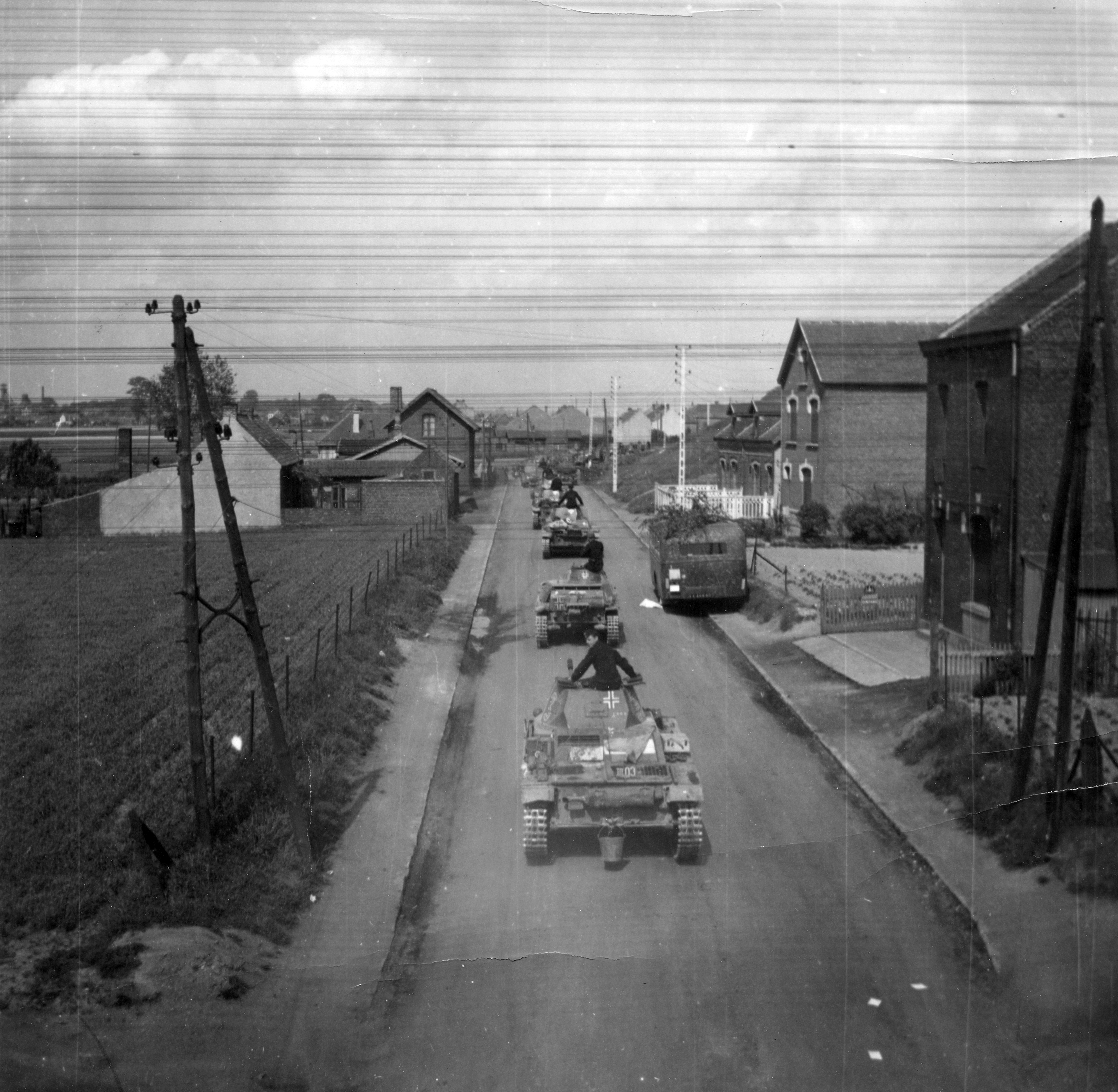
Figure 2. German tanks of the 7th Panzer Division moving through a French town, May-June 1940. Public-domain image from Wikimedia Commons / U.S. National Archives [4].
Strategic Miscalculation
The second major problem was strategy. French military planning relied heavily on static defense, especially the Maginot Line. The Maginot Line was a strong system of fortifications along France’s eastern frontier, but it did not solve the problem of a German attack through Belgium and the Ardennes. Britannica notes that the line ran from the Swiss frontier northward but stopped near the Belgian frontier south of the Ardennes Forest [2].
The Maginot Line itself was not useless. It reflected the memory of World War I and was designed to prevent a direct German invasion across the Franco-German border. The mistake was treating it as a sufficient answer to a new kind of war. German forces did not need to smash through the strongest part of the line. They could bypass it, hold French forces in place, and strike through a less fortified route.
This shows the danger of preparing for the last war. French and Allied leaders expected a slower campaign and placed too much trust in defensive assumptions. They lacked enough flexible backup plans. When the battlefield changed quickly, the Allies struggled to adapt.
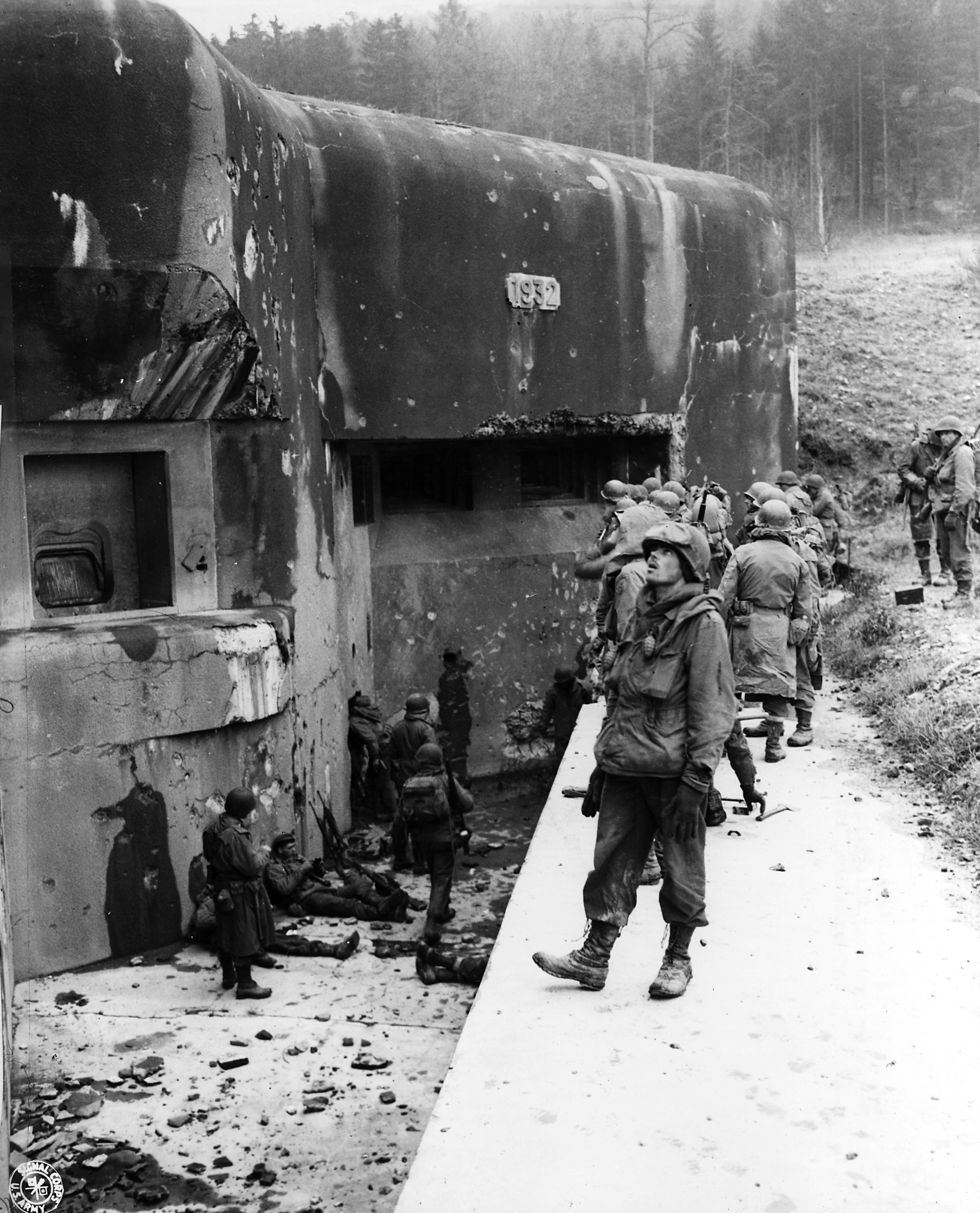
Figure 3. American soldiers at a Maginot Line battery in 1944. The image helps show the scale and solidity of the fortifications, but also the limits of static defense in 1940. Public-domain image from Wikimedia Commons / U.S. Signal Corps [5].
Coordination Failure
The third problem was coordination. British and French forces did not operate under a fully unified command. They had different doctrines, different expectations, and different priorities. The French relied more heavily on traditional defensive concepts, while British forces emphasized mobility and expeditionary operations. These differences made it harder to create one clear response to the German offensive.
Orders were also delayed or misinterpreted. In a fast-moving campaign, a slow order could become useless by the time it arrived. During the Battle of France, German units moved so quickly that Allied commanders often responded to yesterday’s battlefield. Missed opportunities for counterattack allowed German forces to isolate French units and continue their advance.
The German plan also deliberately worsened Allied coordination. Army Group B advanced into the Low Countries, drawing Allied forces northward, while Army Group A attacked through the Ardennes and toward Sedan [2]. This split Allied attention and forced commanders to react to multiple crises at once.
Conclusion
The fall of France in 1940 demonstrates how intelligence failure, strategic miscalculation, and coordination breakdown can reinforce one another. The Allies underestimated the German offensive, relied too much on static defense, and failed to coordinate quickly enough under pressure. Once German forces broke through the Ardennes, Allied decision-making could not keep pace with the speed of the campaign.
The lesson is not simply that France was weak or that Germany was unstoppable. The deeper lesson is that military organizations must be able to question assumptions, communicate clearly, and adapt quickly. France’s defeat reshaped the course of World War II and forced later Allied reforms in command structures, intelligence operations, and combined-arms coordination.
References
- Encyclopaedia Britannica. “Battle of France.” Updated May 3, 2026. https://www.britannica.com/event/Battle-of-France-World-War-II
- Encyclopaedia Britannica. “World War II: The invasion of the Low Countries and France.” https://www.britannica.com/event/World-War-II/The-invasion-of-the-Low-Countries-and-France
- Harry S. Truman Library & Museum. “Map of the Conquest and Liberation of France.” Public domain. https://www.trumanlibrary.gov/maps/m1772-01-map-conquest-and-liberation-france
- Wikimedia Commons. “German tanks of the 7th Panzer Division roll through a French town, May-June 1940.” Public domain / U.S. National Archives. https://commons.wikimedia.org/wiki/File:German_tanks_of_the_7th_Panzer_Division_roll_through_a_French_town,_May-June_1940_(242-EAPC-3-275.35).jpg
- Wikimedia Commons. “Maginot Line 1944.jpg.” Public domain / U.S. Signal Corps. https://commons.wikimedia.org/wiki/File:Maginot_Line_1944.jpg
.jpg)
